April 24, 2026
ECR 2026 Recap: What We Heard About Reading Room Ergonomics
Josh Patrick
READ NOW

August 26, 2026
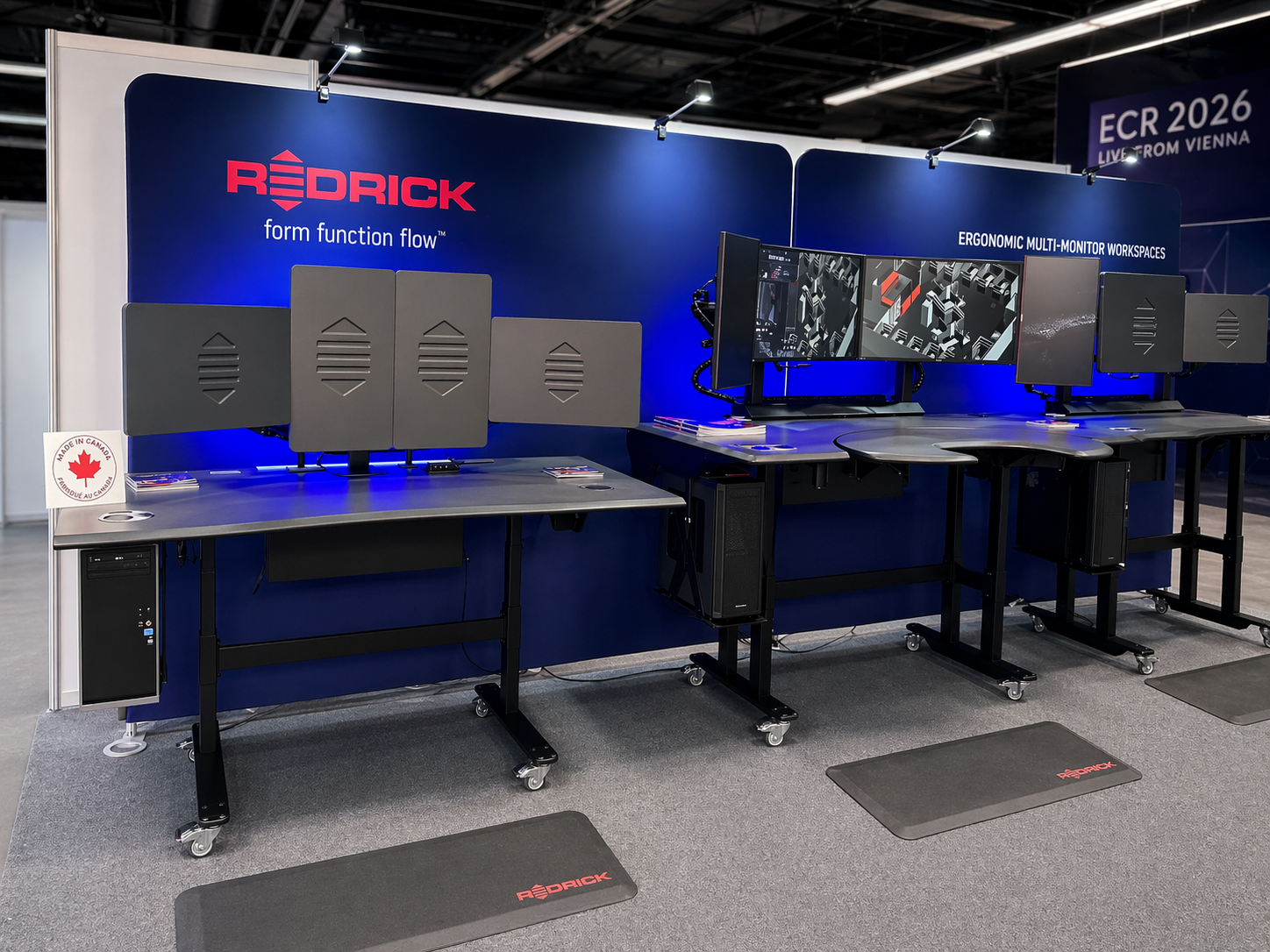
RedRick’s own Steve Reinecke, Senior Director of Business Development, was recently featured in Security Journal Americas, where he shared his perspective on the next evolution of security operations center design: moving beyond traditional ergonomics toward cognitive design.
In the article, Steve examines how modern security operations centers have become high-pressure environments of constant information flow. Operators are no longer monitoring a single system or display. They are often responsible for live video feeds, alarms, analytics platforms, access control systems, cybersecurity dashboards and communication channels — all at once.
That complexity changes the design conversation.
For years, SOC and control room planning has focused heavily on physical ergonomics: adjustable desks, monitor arms, seating and operator comfort. Those elements remain essential. But as Steve explains, the next generation of SOC environments needs to consider how people process information, maintain attention and make decisions over long shifts.
Read the full article in Security Journal Americas: The next evolution of SOC design.
The central idea of Steve’s article is straightforward: the future SOC cannot be designed around technology alone.
More screens, larger video walls and additional software platforms do not automatically create better situational awareness. In some cases, they can increase visual noise, context switching and cognitive overload.
Cognitive design looks at the full operator experience. It considers how workstation layout, monitor positioning, alert visibility, lighting, acoustics and workflow design affect concentration and decision-making.
The goal is not simply comfort. The goal is clarity.
One of the strongest points in the article is Steve’s reframing of a common industry assumption. Security teams often talk about the human operator as the “weakest link.” Fatigue, distraction and inconsistency are real concerns in mission-critical environments.
But the operator is also the organization’s greatest asset.
Technology can collect data, trigger alerts and automate certain workflows. People still interpret context, recognize anomalies and make judgment calls during incidents. In many situations, the speed and quality of human decision-making determine whether a situation escalates or is contained.
That makes operator performance an infrastructure issue, not just a wellness issue.
Steve also highlights a problem many control rooms experience but do not always name: cognitive overload.
When operators are surrounded by too many displays, constant notifications, fragmented systems and poor workstation layouts, the environment can work against them. Alert fatigue, visual overload, static postures and mental exhaustion all reduce the operator’s ability to respond effectively.
This is where workstation design becomes operationally significant.
Small design choices can have a large cumulative effect:
For RedRick, these are not abstract design principles. They are part of how we think about workstations for demanding, multi-monitor environments.
Steve’s article also addresses the role of AI and automation in security operations.
AI can help identify anomalies, flag unusual activity and reduce some of the manual burden placed on operators. But it does not remove the need for human judgment. In many cases, it changes the operator’s role from continuous searching to rapid interpretation and validation.
That shift makes attention even more valuable.
As AI systems generate more information, SOC environments will need to be designed carefully to prevent information overload. The future SOC will require a balance between automation and human-centered design.
At RedRick, we have long believed that workstation design should support the person behind the screen.
That belief applies whether the environment is a radiology reading room, a security operations center or another high-value, multi-monitor workspace. The common thread is sustained focus. Operators and specialists need workstations that adapt to them, reduce unnecessary friction and support performance over time.
Our security console solutions are built around that idea, with features such as motorized vertical monitor adjustment, monitor depth control, sit-stand functionality, cable management and flexible workstation designs. These details are not simply comfort features. In the right environment, they help reduce fatigue, improve clarity and support the operator’s ability to stay focused through demanding shifts.
Steve’s article makes a timely argument: the next evolution of control room design will not be defined only by larger displays or more sophisticated software. It will be defined by how well organizations support the people working inside those environments.
For security leaders planning a new SOC, upgrading existing control room consoles or rethinking operator workstations, cognitive design deserves to be part of the conversation from the beginning.
Because even in an era of AI and automation, the success of every security operation still depends on the person behind the screen.
Read Steve Reinecke’s full article in Security Journal Americas: The next evolution of SOC design.
2025 © RedRick Technologies.
All Rights Reserved.
Web design & developed by Duco Media & Kick Ass Digital Media